 +1 628 313 4513
 Create account - Log in


.png)
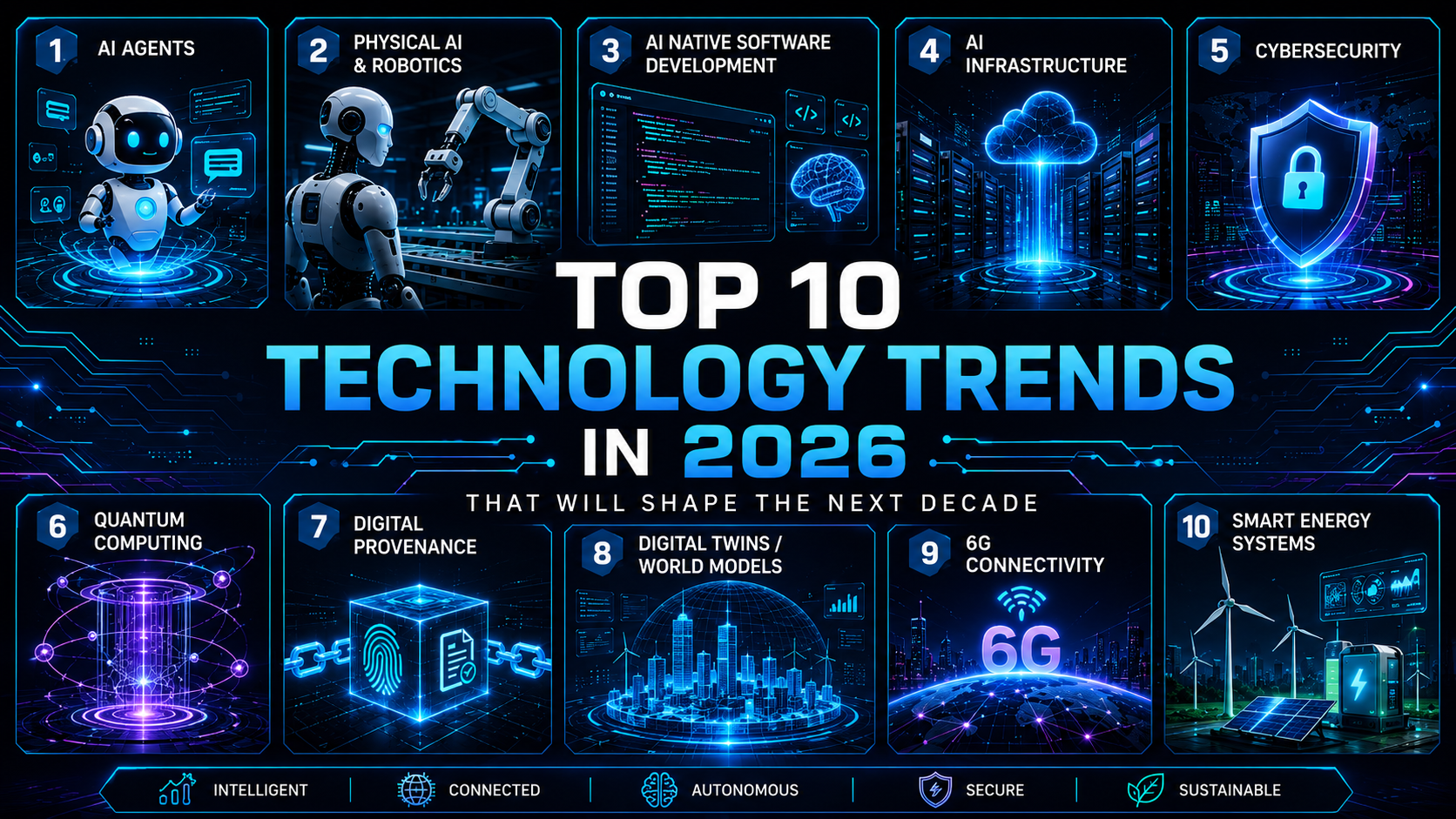
Technology in 2026 is not just about a smarter chatbot or a faster phone. The bigger change is that software can now plan work, machines can react to the physical world, and security tools can look for danger before damage is done. At the same time, networks, data centers, energy systems, and trust tools must grow around these new systems. Gartner’s 2026 trend list centers on AI supercomputing, multiagent systems, AI native development, physical AI, stronger security, confidential computing, and digital provenance. Deloitte also says the focus has moved from AI experiments to results that businesses can measure. The World Economic Forum adds energy systems, world models, quantum safe security, health tools, and new materials to the picture. (Gartner)
For readers searching for technology trends 2026, the key point is simple. A useful trend must solve a real problem. It should help a company work faster, cut waste, lower risk, serve customers better, or create a product that was not practical before. This article explains the top 10 technology trends through that practical view. It also shows what the latest technology 2026 means for IT teams, business owners, and decision makers who need clear answers rather than loud claims.
At NetworkDistri.com, we look at technology through a professional IT lens. The goal is not to tell every company to buy every new tool. The goal is to help people understand which ideas are ready now, which ones need testing, and which ones may shape the future of technology over the next ten years. That approach matters because a poor technology choice can waste money, create security gaps, and make daily work harder instead of easier.
Why Technology Searches Often Lead to the Same Questions
People do not always type a clean question into a search box. Some search for tech trends pboxcomputers, top tech trends otvptech, or tech news wtgtechtrends. Others use phrases such as what technology trends today togtechify, whats trending in technology togtechify, and current trends in tech togtechify. A user may also search what are the latest tech trends h2hnewstech while trying to find a simple list of important changes.
These phrases may look different, but the need behind them is the same. People want to know what is real, what is growing, and what deserves attention. They also want to avoid tools that sound exciting but do not fix a business problem. That is why this guide does more than name the emerging technologies 2026. Each section explains the problem, the likely value, the main risk, and the sensible first step.
The pace of change is also making the question harder. A trend can move from a small test to a common business tool in a short period. Deloitte’s 2026 report describes a move from AI testing toward real business use, while Gartner places connected AI systems, physical AI, new computing platforms, and digital trust among the leading strategic themes. (Deloitte)
1. AI Agents Will Move From Answers to Actions
Generative AI became popular because it could write, summarize, explain, and create. AI agents go a step further. An agent can receive a goal, plan several tasks, use approved tools, check progress, and pass work to another agent. A sales agent might review leads, draft messages, update a customer record, and alert a human when a deal needs personal attention. An IT agent might watch system health, collect logs, suggest a fix, and open a support case.
The problem this trend solves is broken work. Many business processes still depend on people copying information between email, spreadsheets, customer systems, finance tools, and support platforms. That work is slow and easy to get wrong. Multiagent systems can divide a large process into smaller jobs, with each agent handling a clear role. Gartner lists multiagent systems as a major 2026 trend, while Deloitte warns that companies should redesign the full process instead of adding an agent to one small step. (Gartner)
AI agents are among the next big technology trends, but they need control. An agent should have limited access, a clear task, a record of every action, and a human approval point for important choices. Businesses should begin with a process that is repeated often, has clean data, and has a clear result. Customer support sorting, invoice checks, stock alerts, and basic IT service work are sensible starting areas.
2. Physical AI Will Bring Smarter Machines Into Daily Work
Physical AI means software that can sense the real world, make a choice, and control a machine. This includes factory robots, warehouse systems, drones, smart cameras, medical devices, farm equipment, and vehicles. The machine does not only follow one fixed set of steps. It can use cameras, sensors, maps, and trained models to adjust when the situation changes.
This trend solves problems in places where work is unsafe, tiring, slow, or hard to staff. A robot can move heavy goods, inspect a risky site, or repeat a precise task for many hours. A smart camera can find a damaged product before it reaches a customer. A drone can check power lines or farmland without sending a person into a dangerous area. Gartner and Deloitte both place physical AI near the center of their 2026 technology outlooks. NVIDIA also announced new physical AI tools in 2026 for robotics, vehicles, vision systems, and industrial digital twins. (Gartner)
The safe path is not to buy a robot because robots are popular. A company should first find a job with a clear cost, safety issue, or quality problem. It should test the machine in a controlled area, measure errors, and plan what happens when the system is unsure. Human workers also need training because physical AI joins IT, operations, engineering, and safety in one system.
3. AI Native Software Building Will Change How Apps Are Made
Software building is becoming less about typing every line by hand and more about guiding, testing, and checking work created with AI help. AI native development platforms can turn plain instructions into code, screens, tests, documents, and basic system links. This does not remove the need for skilled developers. It changes where they spend their time. More effort moves toward system design, security, data rules, review, and solving unusual problems.
The business problem is the long wait for simple internal software. Many teams need a small tool for stock control, staff requests, reporting, or customer follow up, but the main development team is already busy. AI assisted platforms can help a small team build these tools faster. Gartner expects AI native development to change the size and shape of many software teams by 2030. (Gartner)
These tools are part of next generation platforms that connect AI, cloud services, company data, security rules, and reusable parts. The risk is that fast building can create weak code just as quickly as useful code. Every application still needs access control, testing, backups, clear ownership, and a plan for updates. The best approach is to begin with a low risk internal tool and let experienced developers review the result before wider use.
4. AI Infrastructure Will Become a Business Planning Issue
AI needs more than a model. It needs processors, memory, storage, networking, power, cooling, data, and software that can send each job to the right place. Some tasks belong in a large cloud system. Some should run in a private data center. Others need to run close to a device because the answer must arrive quickly or the data should not leave the site. This mix is making AI infrastructure one of the most important parts of business planning.
Gartner’s 2026 list includes AI supercomputing platforms that combine different kinds of processors and software. Deloitte also points to an AI infrastructure reckoning, where companies must make careful choices about compute cost, placement, networking, and cooling. (Gartner)
The problem is waste. A company can spend heavily on AI and still receive slow results if its data is messy, its network is weak, or it uses an expensive system for every task. IT leaders should match the tool to the job. A small industry trained model may be better than a huge general model for a narrow task. Edge systems may be better for cameras, machines, shops, and remote sites. The winning design will often be a mixed system, not one platform for everything.
5. Cybersecurity Will Try to Stop Attacks Before They Land
Traditional security often reacts after a warning appears. The 2026 direction is more active. Preemptive security tools use threat data, behavior checks, AI, decoy systems, and automatic controls to block or confuse an attacker before major harm is done. AI security platforms also watch how staff and software use AI, helping to reduce data leaks, unsafe prompts, and actions taken by an unapproved agent.
This solves a growing problem. Companies are adding more cloud tools, connected devices, AI systems, and outside services. Every new connection can create another path for attack. Gartner expects preemptive security to take a much larger share of security spending by 2030. It also names confidential computing as a major trend. Confidential computing protects data while it is being used, not only while it is stored or sent. (Gartner)
A sensible plan begins with basics. Know every device and account. Remove access that is no longer needed. Use strong sign in rules. Keep backups away from the main network. Watch unusual behavior. Then add smarter tools where the risk is highest. AI cannot repair poor security habits. It can make a strong security program faster and more aware.
6. Quantum Computing Will Move Closer to Useful Business Work
Quantum computers use a different way of processing information. They are not expected to replace normal computers for common work such as email, websites, or office software. Their value may come from hard problems involving materials, chemistry, risk, routing, and large groups of possible choices. In many early uses, a normal computer, an AI system, and a quantum service work together.
McKinsey reported in April 2026 that more than 300 global companies were working with quantum technology firms, with early activity in life sciences, logistics, finance, and other fields. The report also says the most practical near term path is a mixed approach where quantum systems handle selected parts of a larger job. The World Economic Forum lists quantum simulation for drug discovery among its leading emerging technologies 2026. (McKinsey & Company)
The security side matters now, even before powerful quantum machines arrive. NIST finalized its first three post quantum encryption standards in 2024 and has urged system managers to begin the move. Companies should list where encryption is used, find systems that will be hard to update, and speak with vendors about migration plans. Waiting for a crisis would make the change more costly. (NIST)
7. Digital Provenance Will Help Prove What Is Real
AI can create useful text, images, audio, video, and code. It can also make false content easier to produce. Digital provenance is a way to record where a file came from, who handled it, and what changes were made. It does not judge whether every statement is true. It gives people and systems more evidence about the history of the content.
This trend solves a trust problem. A company may need to prove that a product image came from an approved source, that software has not been changed, or that a public video has a known editing history. Gartner lists digital provenance as a leading 2026 trend. The C2PA Content Credentials standard is designed to store signed information about the source and changes of digital content, giving users signals they can check. (Gartner)
Businesses should start with high value content and software. Brand images, legal files, training material, public statements, and important code deserve clear source records. IT teams should also track outside software parts and updates. Over time, proof of origin may become as normal as a security certificate on a website.
8. World Models and Digital Twins Will Improve Testing
A digital twin is a computer copy of a real object, place, or process. It may represent a factory, warehouse, building, road, machine, or power system. A world model is an AI system that learns how a physical setting behaves, then uses that knowledge to predict what may happen next. Together, these tools let teams test choices in a digital space before changing the real system.
The problem they solve is expensive trial and error. A factory can test a new line layout before moving equipment. A city can study traffic changes before changing a road. A warehouse can test robot paths before putting people and machines in the same area. The World Economic Forum includes world models in its 2026 emerging technology list. NVIDIA has also tied world models, simulation tools, and digital twins to current physical AI development. (World Economic Forum)
This is a strong example of new technology 2026 that should begin with a narrow question. A digital twin is only useful when the real data is good and the model is checked against real results. Teams should choose one costly decision, build the smallest useful model, and compare its predictions with what happens on site.
9. 6G Work Will Shape the Next Era of Networks
5G is still growing, but work on 6G is already setting the rules for the next era. In March 2026, the International Telecommunication Union said experts had agreed on draft performance requirements for IMT 2030, the global framework often called 6G. The planned uses include immersive communication, very reliable connections, large numbers of devices, wider coverage, AI linked communication, and networks that can also sense their surroundings. Formal approval of the draft requirements is expected later in 2026. (ITU)
The business problem is not only speed. Future networks must connect more sensors, machines, vehicles, cameras, and remote workers while using energy wisely and staying secure. They will also need to support fast decisions near the device. That makes network design part of AI planning, factory planning, health systems, transport, and public services.
Most companies do not need to buy 6G equipment today. They do need to prepare their network skills. Clean device records, strong identity checks, good wireless planning, edge computing, private network knowledge, and clear data rules will remain useful as standards change. For NetworkDistri.com readers, this is where upcoming technology meets practical network work.
10. Smart Energy Systems Will Support the Digital Future
AI systems, data centers, robots, electric vehicles, and connected buildings all need power. The next decade will not be shaped by computing alone. It will also depend on how energy is stored, shared, cooled, and managed. One growing idea is everything to grid energy, where buildings, batteries, vehicles, and devices can store power and send some of it back when the grid needs help.
The World Economic Forum placed everything to grid energy at the top of its 2026 emerging technology list. It also highlighted passive radiative cooling materials that can release heat without using electricity. Deloitte’s 2026 technology report points to the growing need for better power and cooling choices around AI infrastructure. (World Economic Forum)
This trend solves two linked problems: rising digital demand and pressure on energy systems. A business can start by measuring where power is used, improving cooling, moving suitable computing jobs to better times or places, and checking whether batteries or local energy sources make sense. Smart energy management will become an IT issue because software controls more of the load.
How Businesses Should Choose the Right Trend
The future of technology will not arrive as one product. It will come through many connected changes in software, security, networks, machines, and energy. The right choice depends on the company’s size, data, staff, risk, and customer needs. A factory may gain more from physical AI. A bank may focus on confidential computing and quantum safe encryption. A retailer may see quicker value from AI agents, edge systems, and better stock data.
The best question is not, “What is the next emerging technology?” The better question is, “Which new tool can solve our most costly problem without creating a bigger one?” This is how a professional IT team avoids waste. It connects every test to a clear result, such as fewer support hours, faster order work, lower downtime, fewer errors, or stronger security.
A practical review can follow these points:
• Write down the business problem in one clear sentence.
• Check whether the needed data is clean, legal to use, and easy to reach.
• Start with a small test that has a clear owner and a clear stop point.
• Measure time, cost, quality, security, and staff impact before wider use.
• Keep human approval for choices that affect money, safety, rights, or customers.
These steps make future technology trends easier to judge. They also help a company avoid buying a tool because a competitor mentioned it. At NetworkDistri.com, this problem first approach helps explain technology in a way that supports both business leaders and IT teams.
What the Next Decade May Look Like
Taken together, the leading 2026 reports suggest that digital systems will become more active. Software will not only store information. It will plan work. Machines will not only repeat fixed moves. They will adjust to what they sense. Networks will not only carry data. They will help support AI, sensing, and fast local decisions. Security will not only wait for alarms. It will try to block danger earlier. (Gartner)
At the same time, trust will become more valuable. Companies will need to show where content came from, how AI made a choice, who approved an action, and how private data was protected. Energy use will also become part of technology design. A fast system that costs too much to power or cool may not be a good system. (Gartner)
The top 10 technology trends in this article are connected, not separate. AI agents need secure access. Physical AI needs strong networks and world models. Quantum work creates new computing options and new security duties. AI infrastructure needs energy and cooling. Digital provenance helps people trust the growing amount of machine made content.
The winners of the next decade will not always be the companies with the biggest budgets. They will be the ones that choose carefully, test honestly, protect data, train staff, and improve useful systems step by step. That is the practical meaning of the future of technology.
10 Frequently Searched FAQs
1. What are the top 10 technology trends in 2026?
The main trends are AI agents, physical AI, AI assisted software building, advanced computing systems, proactive cyber defense, quantum computing, digital content proof, spatial computing, 6G development, and smart energy networks. Together, they will change how companies build products, protect data, connect devices, and serve customers. (Gartner)
2. What are some rapid trends in technology?
Some of the fastest moving areas are AI agents, robotics, edge AI, private cloud systems, AI security, digital twins, and post quantum protection. These areas are growing quickly because businesses want faster work, lower costs, better data safety, and more useful automation across daily operations. (Deloitte)
3. What is the next emerging technology after generative AI?
Agentic AI is a strong answer because it can plan tasks, use tools, and work with other agents. Physical AI is close behind, since it places smart software inside robots, vehicles, machines, and devices. Both trends move AI from giving answers to taking useful action. (Gartner)
4. What are the next big technology trends for businesses?
The biggest business trends include AI agents, smaller industry trained models, AI built software, confidential computing, proactive security, digital proof for content, and smarter networks. The best choice depends on the problem. A company should start with one clear use case, test it, measure it, and improve it. (Gartner)
5. How will technology trends 2026 affect jobs?
Most jobs will not change in the same way. Repeated tasks may be handled by software or machines, while people spend more time checking results, solving unusual problems, speaking with customers, and making choices. Workers who learn AI tools, data safety, and basic automation will have a clear advantage. (Deloitte)
6. What does latest technology 2026 mean for small businesses?
For a small business, the latest technology should save time or reduce risk. Useful examples include AI help desks, smart sales follow up, cloud security, automatic stock alerts, and simple data tools. Buying every new product is not the goal. Solving one costly problem is the better starting point.
7. Which emerging technologies 2026 matter most for IT teams?
IT teams should watch AI agents, AI security platforms, confidential computing, edge AI, post quantum encryption, digital provenance, and early 6G standards. These areas affect systems, networks, data, and trust. Teams should map current tools first, then choose small tests that can be controlled and measured. (Gartner)
8. How will future technology trends change networking?
Networks will need to support more AI traffic, more sensors, more robots, and faster decisions near the device. This will raise demand for strong edge systems, private wireless networks, better traffic control, tighter identity checks, and lower energy use. Network planning will become part of business planning, not just an IT task. (ITU)
9. What upcoming technology should companies invest in first?
The first investment should match the company’s biggest pain point. For many firms, that may be cyber protection, data cleanup, AI support for staff, or better network monitoring. New tools only create value when the data is ready, workers know the process, and results can be checked against a clear goal.
10. How can a company prepare for the future of technology?
Start by listing important systems, data sources, security gaps, and slow work steps. Pick one useful project, set a small budget, assign an owner, and track results. Train staff before wider use. Review privacy, access, and backup rules so growth does not create hidden risk.




